
The Charlotte Perkins Gilman (CPG) Continuum
Mapping the Architecture of Institutional Confinement and Extraction


In 1892, Charlotte Perkins Gilman wrote a story about a woman confined to a room. The wallpaper was yellow. The pattern repeated. She named it before she understood what she was naming. That is often how it works.
This framework carries her name because she saw the architecture before most people could. Confinement dressed as care was still confinement. Rest prescribed as remedy was still control. The room was the institution. The wallpaper was the pattern. She named it.
Her vision had a ceiling she was unwilling to examine. A liberated future built for some women and not others. The continuum requires both things to be true simultaneously. The clarity and the limit. That is not a contradiction. That is the condition of most knowledge built inside imperfect structures by imperfect people trying to see clearly.
This framework is offered in the same spirit.
The Charlotte Perkins Gilman Continuum is not a burnout model.
It is a power model.
The distinction matters. Burnout locates the problem inside the person — her capacity, her resilience, her ability to manage. This framework locates the problem inside the structure.
The institution is failing to support her. It has always been failing to support her. The question is whether that failure is accidental or structural. The evidence that follows suggests it is structural. Not because institutions are malicious. Because of how they are built, what they select for, and what they do when contradictions become visible.
The crisis is not that she becomes exhausted.
The crisis begins when she becomes able to see.
This framework describes a cycle observable across mission-driven institutions of every kind. Nonprofits. Universities. Advocacy organizations. Political movements. Religious institutions. Healthcare systems. Corporations with social missions. Any environment where legitimacy must be preserved when contradictions become visible.
The sector is the original laboratory. But the architecture is not sector-specific.
THE PRECONDITION: HOPE ENTERS
Hope is not incidental to how these institutions function. It is the entry condition.
Mission-driven institutions do not recruit labor. They recruit belief. They attract people who can already see a better future and are willing to work toward it. The most hopeful people apply first. They stay longest. They absorb the most without complaint. They carry the most without acknowledgment.
This is not accidental. This is selection.
Hope is what the institution runs on. Not budget. Not strategy. Not infrastructure. Those matter. But underneath them, sustaining them, is the continuous investment of human belief in the institution’s stated purpose.
The institution attracts hope. Concentrates it. Converts it into labor, commitment, sacrifice, patience, persistence, and tolerance for uncertainty. And then reproduces it — through mission language, through vision statements, through the next hire who arrives believing what the last one arrived believing.
Hope is both the input and the output.
That is the first thing to understand about the cycle. The person did not enter naively. She entered perceptively. She saw something real. The potential was real. The mission was real. The work mattered.
And the institution knew exactly what it was selecting for.
THE CYCLE: WHAT HAPPENS INSIDE
She enters with belief intact.
The institution receives her. It assigns her work commensurate with her capability. Then it assigns her more. Capability becomes justification. Competence becomes load. The additional weight arrives without acknowledgment, without compensation, without being asked. This is not oversight. This is architecture.
She carries it. Because the mission is real. Because leaving feels like abandonment. Because the most hopeful people have the highest threshold for absorbing harm before they name it as harm.
She begins to notice things.
The gap between what the institution claims and what it does. The distance between the values on the wall and the decisions in the room. The pattern of who gets protected and who gets assigned the weight of institutional failure. The way dysfunction travels downward and credit travels up.
She names it internally first. To herself. Then carefully to a trusted colleague. Then in a meeting where the naming is received with procedural acknowledgment and no structural change.
She stays. Because the potential is still real. Because hope is not irrational. Because she has invested years and the investment creates its own gravity.
This is not naivety. This is idealism meeting structure for the first time in the flesh.
The institution, meanwhile, has not changed. It has continued to function as it evolved to function. It has extracted her labor, her expertise, her emotional energy, her institutional knowledge, and her hope. And it has interpreted her continued presence as evidence that the system is working.
She is loadbearing. The structure depends on her holding it. And the structure will not acknowledge that it depends on her holding it, because acknowledgment would require change.
The descent is not collapse. It is accumulation. Weight added incrementally, below the threshold of any single grievance, until the cumulative load becomes visible as a pattern.
And then she sees the pattern.
THE HINGE: SHE BECOMES ABLE TO SEE
This is where most frameworks stop.
They describe exhaustion. They prescribe recovery. They locate the problem in her capacity and the solution in her resilience. Rest. Boundaries. Self-care. Return.
This framework makes a different claim.
Most frameworks locate the crisis in exhaustion. But exhaustion is manageable. The institution has tools for exhaustion. It has wellness programs and employee assistance lines and managers trained to recognize the signs. A tired person can be rested, reassigned, appreciated, promoted.
What it does not have tools for is something else entirely.
What happens when she is not tired.
What happens when she is clear.
The crisis is not that she becomes exhausted. The crisis begins when she becomes able to see.
When she begins to see the pattern not just feel it, but name it, map it, hold it up to the light the institution faces a different kind of threat. Not a person who needs support. A person who has become a witness.
Institutions are more threatened by clarity than by exhaustion.
What happens next is not accidental and it is not personal. It is structural. The institution can have good people and still consume them. The extraction is not a function of intent. It is a function of architecture.
Structurally extractive. Individually variable.
The good manager who genuinely cares and still assigns the loadbearing work without acknowledgment. The mentor who tells her she is extraordinary and still does not protect her when the room turns. The leader who means every word of the mission statement and still sends someone else to deliver the news.
The institution acts through people. The people are not the institution. And the institution’s self-preservation does not require anyone to choose it consciously.
What it requires is accumulated weight. Small decisions. A structure that rewards certain choices and penalizes others. Over time. Until the pattern is the policy even when no policy was written.
She sees this. She names it. And the room responds.
THE DEFENSIVE TURN: THE ROOM RESPONDS
Accountability approaches. The room defends itself.
Not with aggression. Aggression would be nameable. The defensive turn is more sophisticated than aggression and more durable. It operates through procedures, language, and the slow erosion of the witness’s credibility.
The first move is fog.
Structured Fog is not confusion. It is the deliberate maintenance of ambiguity at precisely the points where clarity would require accountability. Contradictory narratives that cannot both be true but are never resolved. Standards that move when she approaches them. Processes that produce documentation without producing change. The appearance of responsiveness without the substance of it.
The fog is both a tactic and an atmosphere. It can be produced consciously or reproduced without intention. The structure maintains it either way. And the woman inside it begins to question not the institution but her own perception. That is the design.
The second move is proliferation.
Argument Proliferation is what happens when accountability approaches and the discussion fragments. Was it really that bad. Was it intentional. Did the policy exist. Was the policy followed. Was the outcome foreseeable. Was communication clear. Was the messenger credible. Is this the right venue. Is this productive.
The point is not to win any individual argument. The point is to ensure there are always more arguments than accountability can survive. The question multiplies until the original clarity is buried under the weight of its own interrogation.
She entered the conversation with a pattern. She exits it defending her perception of individual incidents.
The third move is replacement.
If the fog does not hold and the proliferation does not exhaust her the institution moves to its final resource. The Nonprofit Cycle completes itself. The dysfunction is attributed to her. The structure is preserved. She is replaced by someone who has not yet learned to see.
And the institution recruits the next believer.
Fresh hope. New investment. The cycle begins again.
The cycle does not require malice. It does not require awareness. It requires only that the structure continue doing what structures do — preserve themselves, reproduce their conditions, and recruit the next generation of believers.
THE INHERITANCE: THE LANGUAGE TRAVELS
And then she names it.
Not in a meeting. Not in a performance review. Not in an exit interview that will be filed and forgotten. She names it in language that travels. An essay. A framework. A lexicon. A conversation that becomes a pattern that becomes a map.
This is the part the institution did not anticipate.
It anticipated her exhaustion. It had tools for that. It anticipated her departure. It had processes for that. It anticipated her grief and her anger and her silence. It had absorbed all of those before from all the women who came before her.
It did not anticipate that she would build language for what it did.
Miranda Fricker named the gap in collective language that leaves experience without words. What she described was passive. A collective failure.
What this framework names is active. The absence of language is not an oversight. It is a resource. Structured Fog is not a passive gap. It is a gap the institution chooses and maintains.
When she builds the language anyway the resource is gone.
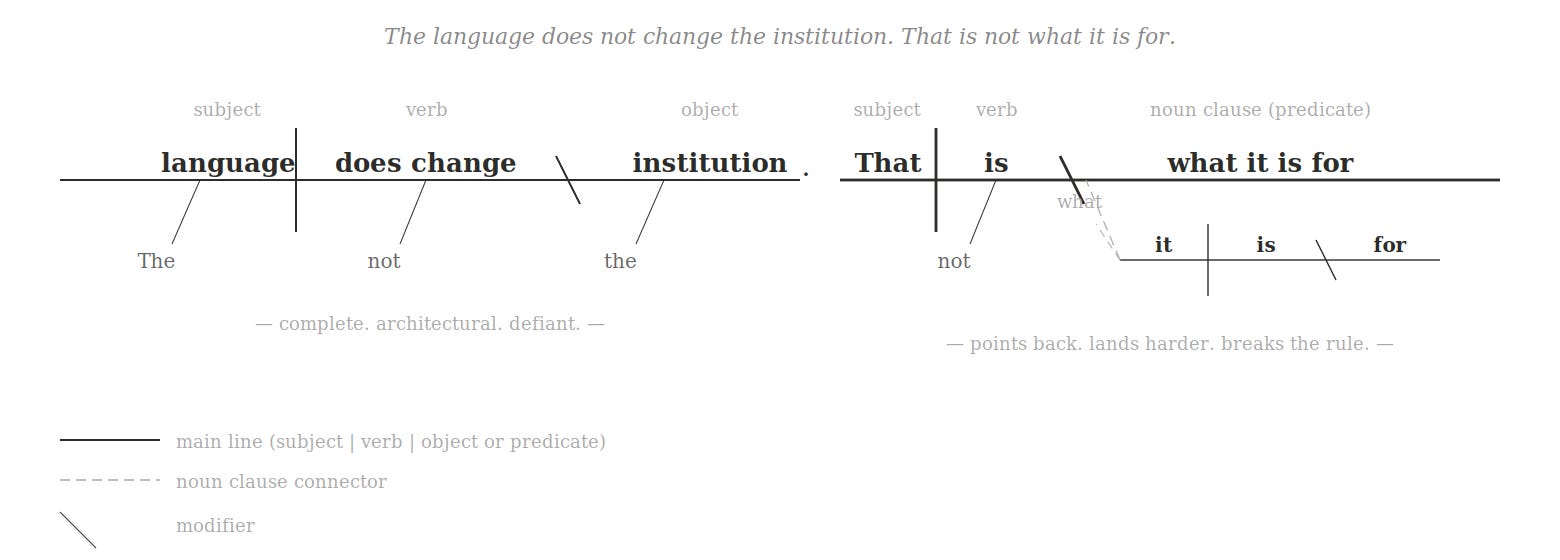
The language does not change the institution. That is not what it is for.
What it changes is the attribution. What felt like personal failure was most often not personal failure. The exhaustion that read as inadequacy was most often not inadequacy. The doubt that accumulated over years — was I not good enough, too much, too ambitious, not ambitious enough — was most often the institution’s dysfunction successfully misassigned.
She is enough. She was always enough. She was doing enough. The system was not.
Once she understands that, the weight does not disappear. But it goes back to where it belongs.
And the language travels. To the woman who will enter the institution next year still believing in its potential. To the woman who is inside it now and cannot yet name what she is carrying. To the researcher who recognizes the map and extends it.
A map does not change the territory. But it changes what is possible inside it.
The next person starts with a map.
Charlotte Perkins Gilman wrote a story about a yellow room in 1892. She named the wallpaper. The institution she was describing did not change because she named it. Not immediately. Not completely. Not without resistance.
But the language traveled.
She gave it language. And the language traveled further than she did.
That is the inheritance.
That is what this is.
* This is a dominant pattern, not a totalizing explanation.
** This framework describes institutional dynamics rather than inherent traits of individuals or groups.
*** This framework emerged from lived experience inside mission-driven institutions and from observing recurring patterns across nonprofit, philanthropic, and advocacy systems. It is offered as a map, not the map.
****CPG saw the architecture before most people could. She named the wallpaper. She understood that confinement dressed as care was still confinement. And her vision had a ceiling she was unwilling to examine; a liberated future built for some women and not others. I name this after her because the continuum requires both things to be true simultaneously: the clarity and the limit. That is exactly what the continuum is designed to hold.
*****This is a structural interpretive model of institutional dynamics, not an empirical claim about all individuals within any group.
In dialogue with Miranda Fricker’s account of hermeneutical injustice and the hermeneutical lacuna.
Trust the reader. Cut until it hurts. Earn the silence.